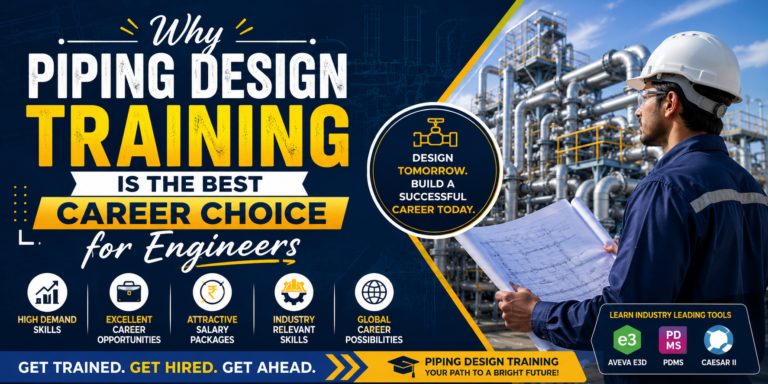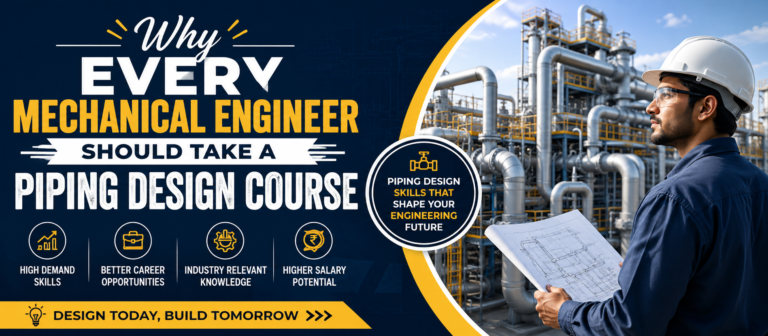




Piping systems are an essential part of industries such as oil and gas, petrochemicals, refineries, power generation, chemical processing, pharmaceuticals, water treatment, and manufacturing. These systems are responsible for transporting liquids, gases, chemicals, steam, and other materials safely between equipment and different sections of an industrial facility.
Because of this, companies need professionals who understand how piping systems are planned, designed, documented, analyzed, and implemented. A Piping Design Course can help engineering students, diploma holders, designers, and working professionals develop the technical knowledge required to enter or advance in this field.
A well-structured course generally combines piping fundamentals, engineering principles, drawings, layouts, industry codes, equipment connections, supports, stress concepts, and design software.
What Is a Piping Design Course?
A Piping Design Course is a professional training program focused on the design and development of piping systems used in industrial plants. It explains how engineers and designers convert process requirements into practical piping layouts and engineering drawings.
The course usually starts with fundamental concepts such as pipe sizes, pipe thickness, fittings, valves, materials, insulation, and piping components. More advanced topics may include equipment layout, piping isometrics, pipe supports, pressure vessels, stress analysis, fabrication, and industry standards.
The objective is not simply to learn how to create drawings. Students should understand why a particular pipe route, component, support, material, or equipment connection is selected and how those decisions affect safety, operation, maintenance, and project cost.
Why Is Piping Design Important?
Piping design directly influences the safety and efficiency of an industrial plant. Poorly designed piping can create problems involving pressure, temperature, vibration, thermal expansion, accessibility, maintenance, and equipment operation.
A good piping layout considers several factors, including:
- Process requirements
- Equipment location
- Fluid flow
- Safety
- Accessibility
- Maintenance requirements
- Pipe flexibility
- Thermal expansion
- Material selection
- Construction requirements
- Applicable engineering codes and standards
For example, piping around pumps and heat exchangers must be arranged carefully so that the equipment can operate correctly and remain accessible for inspection and maintenance.
What Does a Piping Design Course Teach?
The exact syllabus differs between training providers, but a comprehensive program can cover several important areas.
1. Piping Fundamentals
Students first learn the basic terminology and components used in industrial piping. Topics may include:
- Types of pipes
- Pipe sizes and thickness
- Pipe fittings
- Flanges
- Valves
- Gaskets
- Bolts
- Piping materials
- Insulation
- Piping components
Understanding these fundamentals is important because advanced piping design depends on a strong knowledge of individual components.
2. P&ID and Engineering Drawings
Piping designers need to understand engineering drawings and process documentation. Training can include reading and interpreting P&IDs, PFDs, equipment drawings, piping layouts, and isometric drawings.
A P&ID provides important information about process equipment, piping, valves, instrumentation, and flow relationships. Learning to interpret these documents is therefore an important step toward working on real industrial projects.
3. Piping Layout Design
Piping layout is one of the most important parts of the discipline. Designers need to determine suitable routes for pipes while considering equipment arrangement, accessibility, safety, operation, and maintenance.
Students can learn concepts such as:
- Pipe routing
- Equipment arrangement
- Nozzle orientation
- Pipe rack layouts
- Plant layouts
- Elevations and sections
- Access requirements
- Maintenance clearances
The goal is to create a practical arrangement that satisfies both engineering and construction requirements.
4. Piping Isometrics
Piping isometric drawings provide detailed information required for fabrication and construction. A course may teach students how to understand and prepare isometric drawings, identify dimensions, interpret symbols, and prepare material or bill-of-material information.
Isometrics are particularly important because they connect the design stage with fabrication and site execution.
5. Pipe Supports
Pipes cannot simply be installed without proper support. Depending on the system, different types of supports, guides, anchors, hangers, and other arrangements may be required.
A Piping Design Course can introduce:
- Support types
- Support locations
- Guides
- Anchors
- Hangers
- Spring supports
- Support spacing
- Basic support calculations
Understanding support principles also helps designers coordinate effectively with piping stress engineers.
Piping Engineering Course vs. Piping Design Course
The terms Piping Engineering Course and Piping Design Course are closely related, but they can have different areas of emphasis.
A design-focused program generally concentrates more heavily on layouts, drawings, 2D/3D modeling, equipment arrangement, routing, and design documentation.
A broader Piping Engineering Course may cover design along with engineering calculations, material specifications, piping codes, stress analysis, fabrication, erection, inspection, and project engineering.
For example, a piping engineering curriculum may include P&ID interpretation, piping material classes, equipment nozzle orientation, pipe supports, stress analysis basics, fabrication, erection, and software training.
For someone planning a career in industrial piping, understanding both design and engineering concepts can be highly beneficial.
Software Skills in Piping Design
Modern piping projects rely heavily on engineering and design software. Depending on the role and company, professionals may encounter tools such as:
- AutoCAD
- AVEVA E3D
- AVEVA PDMS
- Smart 3D/SP3D
- Navisworks
- CAESAR II
- PV Elite
3D plant design software is particularly useful for creating equipment and piping models, coordinating different disciplines, and identifying potential clashes before construction.
Online Piping, for example, lists training options covering AVEVA E3D, SP3D, PDMS, CAESAR II, PV Elite, and piping design engineering.
Who Can Take a Piping Design Course?
A Piping Design Course can be useful for both freshers and professionals. Depending on the course requirements, suitable learners may include:
- Mechanical engineering graduates
- Diploma holders
- Civil engineers
- Chemical engineers
- Electrical and instrumentation professionals
- Structural engineers
- Draftsmen
- Working engineering professionals
- People looking to transition into piping design
Some programs specifically mention mechanical, civil, structural, electrical, instrumentation, and chemical engineering backgrounds, as well as diploma and drafting professionals.
However, students should check the eligibility requirements of an individual training provider before enrolling.
Career Opportunities After Piping Design Training
Piping is used across numerous industries, creating opportunities in different engineering and design roles.
Depending on qualifications, skills, and experience, professionals can pursue positions such as:
- Piping Designer
- Piping Design Engineer
- Piping Layout Engineer
- Piping Draftsman
- Piping Engineer
- 3D Plant Designer
- Piping Stress Engineer
- Piping Project Engineer
- Piping Detailer
Potential industries include oil and gas, EPC companies, petrochemical plants, refineries, power plants, chemical industries, pharmaceuticals, water treatment, shipbuilding, food processing, cement, mining, and other process industries.
Benefits of Learning Piping Design Online
Online training can be particularly convenient for working professionals and students who cannot attend classroom sessions.
Some potential benefits include:
Flexible learning: Learners can study around their existing schedule.
Reduced travel: Online learning removes the need to travel to a training center.
Access to project-based exercises: Practical exercises can help students connect theory with real-world applications.
Software exposure: Learning relevant engineering software can improve technical capabilities.
Career development: Additional technical skills can help professionals prepare for new responsibilities or job opportunities.
Online Piping states that its training includes online live classes and tutorial-based learning, with flexible scheduling and technical support.
How to Choose the Right Piping Design Course
Before enrolling, students should look beyond the course title and evaluate the actual curriculum. A good program should ideally provide a balance between theoretical knowledge and practical application.
Consider checking:
- Course syllabus – Does it cover piping fundamentals, layouts, drawings, supports, and engineering concepts?
- Software training – Are relevant tools such as E3D, PDMS, SP3D, AutoCAD, or CAESAR II included?
- Practical projects – Does the course provide exercises based on realistic industrial scenarios?
- Trainer experience – Do instructors have relevant industry experience?
- Learning format – Is it live, recorded, or a combination?
- Course support – Is technical assistance available during and after training?
- Certification – Does the provider issue a course completion certificate?
- Career preparation – Does the program help students understand interviews and industry expectations?
These factors can help learners choose training that develops practical skills rather than simply providing theoretical information.
Conclusion
A Piping Design Course can be a valuable learning path for anyone interested in industrial plant design, particularly in sectors such as oil and gas, petrochemicals, power, chemicals, and EPC. The field combines engineering knowledge, technical drawings, 3D modeling, equipment arrangement, piping layouts, materials, supports, and industry practices.
For professionals who want broader knowledge, a Piping Engineering Course can complement design skills by introducing areas such as piping specifications, stress analysis, fabrication, inspection, and project execution.
If you are looking for structured online training in piping design and related engineering disciplines, you can explore the courses available at Online Piping. The platform provides training options covering piping design and engineering along with software-focused programs such as AVEVA E3D, SP3D, PDMS, and CAESAR II.
Choosing the right training program, practicing consistently, and developing both design and engineering knowledge can help build a stronger foundation for a career in the growing field of industrial piping.