




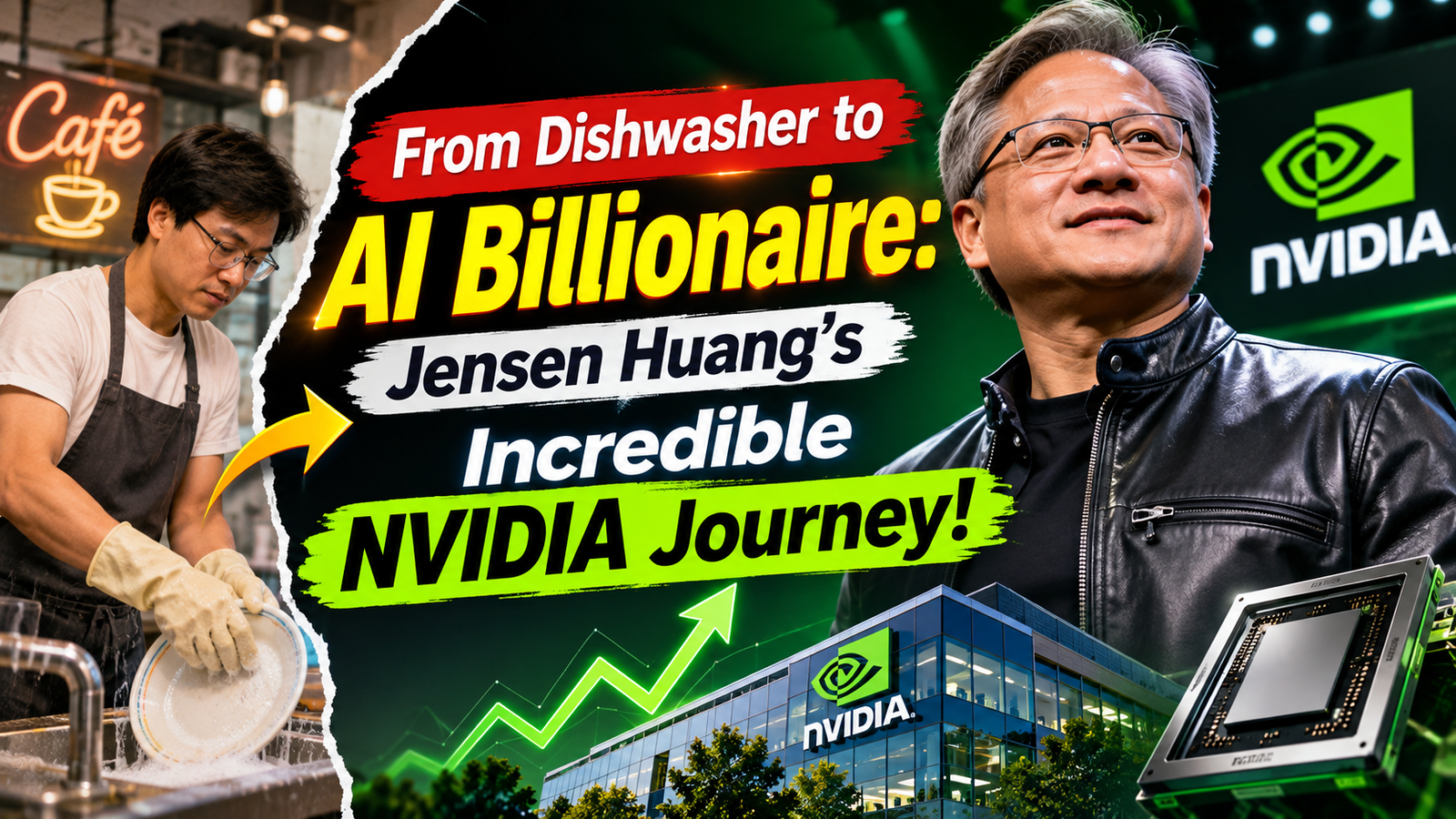
A journey from humble beginnings to becoming one of the most influential figures in the global technology industry, Jensen Huang’s story is a powerful example of how determination, innovation, and long-term vision can change the world. From washing dishes and cleaning tables at a restaurant to co-founding NVIDIA, one of the world’s most valuable technology companies, Huang has built a remarkable legacy over more than three decades.
Today, his name is closely associated with artificial intelligence (AI), advanced computing, graphics processing units (GPUs), and the future of technology. But his success did not happen overnight. It was the result of years of hard work, calculated risks, difficult decisions, and an extraordinary belief in the potential of computing.
Who Is Jensen Huang?

Jensen Huang is the co-founder, president, and CEO of NVIDIA. Born on February 17, 1963, in Taiwan, Huang moved to the United States during his childhood.
He grew up in a family that valued education, discipline, and hard work. His early life involved several challenges, including adapting to a new country and building a future in an unfamiliar environment.
Huang attended Oregon State University, where he studied electrical engineering. Later, he earned a master’s degree in electrical engineering from Stanford University.
Before establishing NVIDIA, he gained professional experience working at technology companies, including Advanced Micro Devices (AMD) and LSI Logic. These experiences helped him understand the semiconductor industry and develop the technical knowledge that would eventually support his entrepreneurial ambitions.
From Washing Dishes to Learning the Value of Hard Work
One of the most interesting parts of Jensen Huang’s early life is his experience working at a restaurant called Denny’s.
During his younger years, he worked as a dishwasher and cleaner at the restaurant. His responsibilities included washing dishes, cleaning tables, and handling other basic tasks.
Although these jobs were far removed from the world of advanced technology, they helped shape his understanding of discipline, responsibility, and the importance of hard work.
Huang has often spoken positively about his early experience at Denny’s. Interestingly, the restaurant also became an important part of NVIDIA’s history because the company’s founding idea was discussed over a meal at a Denny’s restaurant in California.
His journey demonstrates that professional success does not depend on where someone starts. What matters is the willingness to learn, improve, and pursue bigger opportunities.
The Birth of NVIDIA in 1993

In 1993, Jensen Huang joined hands with Chris Malachowsky and Curtis Priem to establish NVIDIA.
At that time, the personal computer and gaming industries were growing, but advanced graphics technology was still developing. The founders believed that specialized graphics processors could transform how computers handled visual information.
They started NVIDIA with a vision to create powerful graphics technology for computers and eventually expand into broader computing markets.
However, the early years were far from easy.
Building semiconductor technology required significant investment, technical expertise, and patience. The company also faced intense competition from established players.
Despite these challenges, Huang continued leading the company with a long-term vision.
NVIDIA’s Turning Point: The Success of Graphics Processing Units
One of NVIDIA’s biggest breakthroughs came with its focus on graphics processing technology.
In 1999, the company introduced the GeForce 256, which NVIDIA marketed as the world’s first GPU.
This innovation helped establish NVIDIA as a major player in the computer graphics industry.
GPUs were initially developed primarily for gaming, 3D graphics, and visual computing. However, researchers eventually discovered that their parallel processing capabilities could also be useful for scientific research, machine learning, and artificial intelligence.
This opened the door to an entirely new market.
Rather than limiting NVIDIA to gaming hardware, Huang recognized the broader potential of GPU computing.
That decision would become one of the most important strategic moves in the company’s history.
How NVIDIA Became a Major Force in Artificial Intelligence

The next major chapter in NVIDIA’s journey was artificial intelligence.
In 2006, NVIDIA introduced CUDA, a parallel computing platform that allowed developers to use GPUs for general-purpose computing beyond traditional graphics applications.
This technology helped researchers and developers use NVIDIA GPUs for complex calculations, scientific research, deep learning, and AI development.
Over time, NVIDIA became an essential technology provider for the growing artificial intelligence industry.
Its products and platforms began powering:
-
Artificial intelligence applications
-
Large language models
-
Data centres and cloud computing
-
Autonomous vehicle technology
-
Robotics and industrial automation
-
Scientific research and simulations
-
Generative AI systems
As demand for AI computing increased, NVIDIA’s GPUs became increasingly important to technology companies, research institutions, and cloud service providers around the world.
The AI Boom Changed NVIDIA’s Future
The global AI boom significantly accelerated NVIDIA’s growth.
Companies investing in artificial intelligence needed powerful processors capable of training and running increasingly sophisticated models. NVIDIA’s hardware and software ecosystem positioned it strongly in this expanding market.
Its data-centre business became a major growth engine, while its AI platforms attracted customers across several industries.
Major technology companies began investing heavily in NVIDIA’s computing infrastructure to develop their AI capabilities.
This transformation changed NVIDIA from a company primarily associated with gaming graphics into one of the most influential companies in the global AI infrastructure market.
Jensen Huang’s long-term investment in GPU computing and software development helped the company benefit from this technological shift.
33 Years of Leadership: What Makes Jensen Huang Different?
Since NVIDIA was founded in 1993, Jensen Huang has remained its CEO, making his leadership journey particularly remarkable in the technology industry.
Several factors have contributed to his success.
1. Long-term vision: Huang recognized the potential of GPU computing long before artificial intelligence became a mainstream business priority.
2. Continuous innovation: NVIDIA continued investing in new technologies rather than relying only on its early success in gaming graphics.
3. Risk-taking ability: The company made major investments in technologies that took years to become commercially successful.
4. Strong execution: NVIDIA built not just powerful chips but also a software ecosystem that made its hardware valuable to developers and businesses.
5. Adaptability: The company successfully expanded from gaming into professional visualization, high-performance computing, automotive technology, and artificial intelligence.
His leadership demonstrates the importance of thinking beyond immediate business opportunities and preparing for future technological changes.
NVIDIA’s Global Impact and Jensen Huang’s Legacy
Today, NVIDIA is a central player in the global technology ecosystem. Its products are used by businesses, researchers, developers, universities, and governments.
The company’s influence extends beyond computer gaming and graphics. Its computing platforms are helping shape developments in medicine, engineering, robotics, autonomous vehicles, and artificial intelligence.
Jensen Huang has also become one of the most recognizable leaders in the technology industry. His signature black leather jacket, energetic product presentations, and ambitious vision have made him a prominent figure at major technology events.
His journey is especially inspiring because he spent more than three decades building the company rather than chasing overnight success.
Conclusion: A Journey That Proves Big Dreams Can Start Small
Jensen Huang’s journey from washing dishes at Denny’s to leading NVIDIA is more than a story of financial success. It is a story of vision, persistence, innovation, and the courage to build something that once seemed impossible.
When NVIDIA was founded in 1993, artificial intelligence was not the massive global industry it is today. Yet Huang and his team invested in technologies that eventually became fundamental to modern AI computing.
More than 33 years later, NVIDIA stands as a global technology powerhouse, and Huang’s leadership continues to influence the direction of the industry.
His story delivers a powerful message to aspiring entrepreneurs and young professionals: Your starting point does not define your destination. Your vision, determination, and ability to keep moving forward can shape your future.